
01
It is a pleasure when, rising in the morning, I go outside and find a flower that has bloomed that was not there yesterday.
Tanoshimi wa / asa okiidete / kino made / nakarishi hana no / sakeru miru toki
For the boys and girls of yesteryear
Showa no Kodomotachi
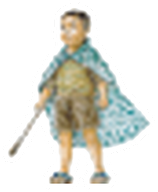

Tachibana Akemi was a poet born in the Fukui domain in the late Edo period (Bakumatsu).
From his Dokurakugin, poems on the simple pleasures found in everyday life, these dolls recreate scenes of nature, married life and family love.
Completed March 2005 / Collection of the Tachibana Akemi Memorial Literary Museum, Fukui (on permanent display). Commissioned by the City of Fukui, these “Dokurakugin Dolls (Dokurakugin Ningyo)” recreate the scenes of three tanka from the Dokurakugin.
01
It is a pleasure when, rising in the morning, I go outside and find a flower that has bloomed that was not there yesterday.
Tanoshimi wa / asa okiidete / kino made / nakarishi hana no / sakeru miru toki

02
It is a pleasure when, on the rare occasions we have fish, the children all eat it, crying, “Delicious, delicious!”
Tanoshimi wa / mare ni uo nite / kora mina ga / umashi umashi to / iite kuu toki

03
It is a pleasure when my wife sets up the loom, weaves new cloth, and sews it into a robe for me to wear.
Tanoshimi wa / hata oritatete / atarashiki / koromo o nuite / tsuma ga kisuru toki
Never mingling with the poetry circles of the capital, he lived out his life quietly as a provincial poet in honest poverty. He revered as his ancestor Tachibana no Moroe, a powerful statesman of the Nara period who served as both Minister of the Right and Minister of the Left, and as Moroe's descendant he held to an unwavering pride even amid the hardships of daily life—loving his country, cherishing peace and loving his family.
As a scholar of kokugaku, Akemi developed a distinctive poetic style grounded in a deep understanding of ancient verse, and he is said to have influenced Matsudaira Shungaku, the enlightened lord of the Echizen domain, in many ways.
His poems are distinguished by their subjects, taken from everyday life, and their plain, familiar language.
Akemi wrote frankly about the realities of his own life, from the fleas and lice that plagued him to the bamboo sprouting through his earthen floor, and within that life he sang of small pleasures such as eating fish or simmered tofu.
In particular, the tanka known as the Dokurakugin, which begin with “Tanoshimi wa” (“It is a pleasure”) and end with “… toki” (“when …”), capture the subtleties of daily life directly, in simple words.
At a time when poetry about the beauties of nature—flowers, birds, wind and moon (kacho fugetsu)—was the mainstream, Akemi stood out as a singular presence.
Masaoka Shiki later praised his posthumous collection highly, and in 1994, at the welcoming ceremony for the state visit of the Emperor and Empress of Japan to the United States, President Clinton closed his welcome speech with the poem quoted above: “It is a pleasure when, rising in the morning, I go outside and find a flower that has bloomed that was not there yesterday.” With that, Akemi was suddenly in the spotlight.
The City of Fukui has held nationwide open calls for poems inspired by the Dokurakugin, and more than 50,000 “Tanoshimi wa” poems have been submitted so far.
And this year (2005), as part of the 10th-anniversary program of the Tachibana Akemi Memorial Literary Museum, the City of Fukui entrusted me with a project to express the world of Akemi's poetry in dolls. As someone who has been touched by Akemi's spirit, I sincerely hope this project will help the message he left us—“the happiness of ordinary people, just as they are”—spread far and wide and take deep root.
Ishii Michiko
We would love
to hear from you.
Hosting an exhibition, a display lease for your facility, licensing the works, or stocking our photo books and postcards—one form covers every inquiry.