Photo Books

Two photo stories.
The photo book series “Photo Story: Showa no Kodomotachi” presents doll artist Ishii Michiko’s Showa no Kodomotachi (Children of the Showa Era) dolls, which depict scenes from the Showa 30s (1955–1964), as photographed by Yamamoto Kunihiko. It comes in two volumes, Hometown (Furusato) and People of the Sea (Umi no Hito), with a caption for every work.
The books are available from our Online Shop.
Hometown (Furusato)
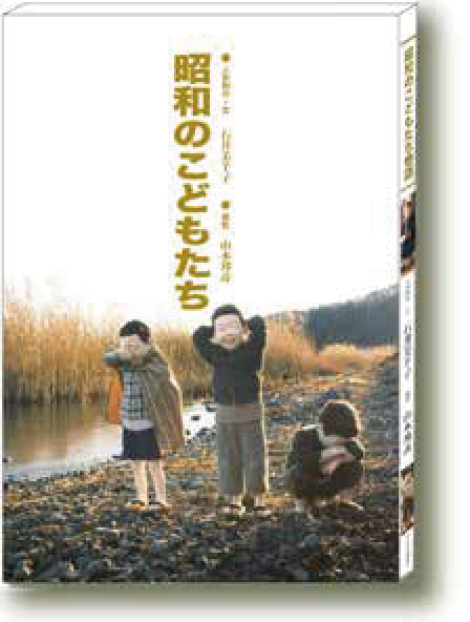
Photo Story: Showa no Kodomotachi — Hometown (Furusato)
¥2,200 (tax included)
A photo book of doll works on the theme of the Japanese as a farming people in the Showa 30s.
- Dolls and text
- Ishii Michiko
- Photography
- Yamamoto Kunihiko
- Specifications
- 62 pages; four-color printing with a high-definition 700-line screen
A world where anyone can return to a child’s heart—
not as grandpa or grandma,
but as the mom or dad
who watched over their little ones fifty years ago.
The world of Showa no Kodomotachi
brings back that gentle feeling.
Share it to spark new connections,
or give it as a get-well gift.
Works Included
The works featured in this book.
From the Afterword
After the war, demobilized soldiers from overseas and repatriates from China returned home in great numbers, setting off a rush of marriages and births.
This was the postwar baby boom: some 10 million babies were born between 1947 and 1950 (Showa 22–25).
It marked the birth of the baby-boom generation, whose presence would be keenly felt throughout the turbulent history of the Showa era.
Over the 75 years since the war, the sheer energy of their numbers became a force that transformed Japanese society from the ground up and laid the foundations of a lasting, peaceful society.
Now that the population explosion has ended, however, Japan—ahead of the rest of the world—must confront fundamental, uniquely human problems that humankind is facing for the first time in history.
These are the problems of a super-aged society and a declining birthrate.
The populations of towns and villages, which peaked between 1965 and 1984 (the Showa 40s and 50s), have turned to decline through depopulation. Local industries have withered, and many communities are becoming “marginal villages” (genkai shuraku) on the path to disappearing altogether. As of a survey in April 2015 (Heisei 27), there were reportedly some 16,000 such marginal villages.
The older population will peak in 2040–2045.
Across Japan, histories that have continued since the days the land was first settled are disappearing, and the focus is shifting from promoting industry to the problems of everyday living.
The next 20 to 30 years will be an era of many deaths, with the number of deaths each year rising sharply.
Where is Japan heading?
As the Buddhist teaching somoku kokudo shikkai jobutsu—that grasses, trees and the land itself all attain Buddhahood—reminds us, we humans are part of the natural world. Would it not be truly Japanese to entrust ourselves to nature and reflect from there?
To that end, we will need death education in the broadest sense: one that sees death, which comes to us all, as part of how we design our lives.
People of the Sea (Umi no Hito)
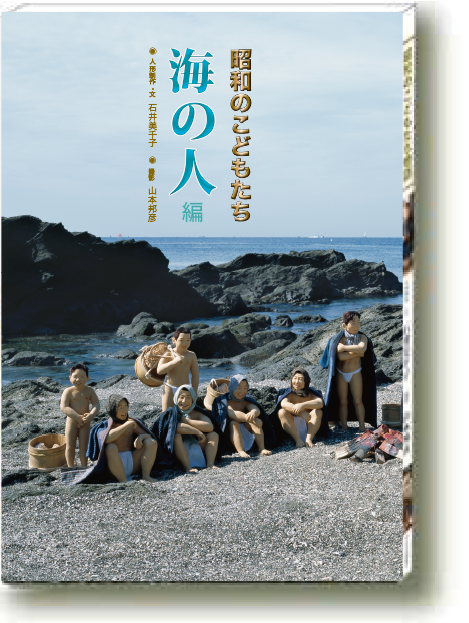
Photo Story: Showa no Kodomotachi — People of the Sea (Umi no Hito)
¥2,200 (tax included)
Part 2 of the Photo Story series. People of the Sea is a requiem, dedicated to those affected by the Great East Japan Earthquake (2011).
- Dolls and text
- Ishii Michiko
- Photography
- Yamamoto Kunihiko
After the war,
what Japan had left
were the mountains and rivers of home,
the timeless sea,
and the bounty of nature.
This is People of the Sea,
the sequel to Showa no Kodomotachi,
portraying those who live with the sea.
Works Included
The works featured in this book.
From the Afterword
After the war, demobilized soldiers from overseas and repatriates from China returned home in great numbers, setting off a rush of marriages and births.
This was the postwar baby boom: some 10 million babies were born between 1947 and 1950 (Showa 22–25).
It marked the birth of the baby-boom generation, whose presence would be keenly felt throughout the turbulent history of the Showa era.
In little more than thirty years after the war, Japan had built its infrastructure and become a prosperous nation free from hunger—a miraculous recovery that seemed to fulfill one of humanity’s dreams.
It became the world’s second-largest economy by GNP after the United States, and went on to become the first country in the world to achieve such longevity.
Though many problems lay hidden behind this rapid growth, in 2010 (Heisei 22) Japan’s population reached 128 million, the highest in its history, and then began to decline.
At the same time, the social security burden of providing relief to the victims of rapid economic growth came to light, exposing the distortions of the population explosion.
As social security costs swell with the growing number of older people, the baby-boom generation will be at the center of the looming “2025 problem” and “2035 problem.” So that they can face these challenges as their own, I hope this book will be read and passed on as a way to recall what they share: the games and daily scenes of their childhood, the natural world around them, and the people dear to them whom they met along life’s way—family and friends.
Through the Showa no Kodomotachi dolls—the landscape of memory, one might say, of the baby-boom generation—I hope readers will reflect anew on what gives their lives meaning in the years ahead.
And to the children who will shape the next generation, I hope this book conveys the strength, kindness and resilience of human beings that transcend time and place.
Contact
We would love
to hear from you.
Hosting an exhibition, a display lease for your facility, licensing the works, or stocking our photo books and postcards—one form covers every inquiry.